

Table of contents
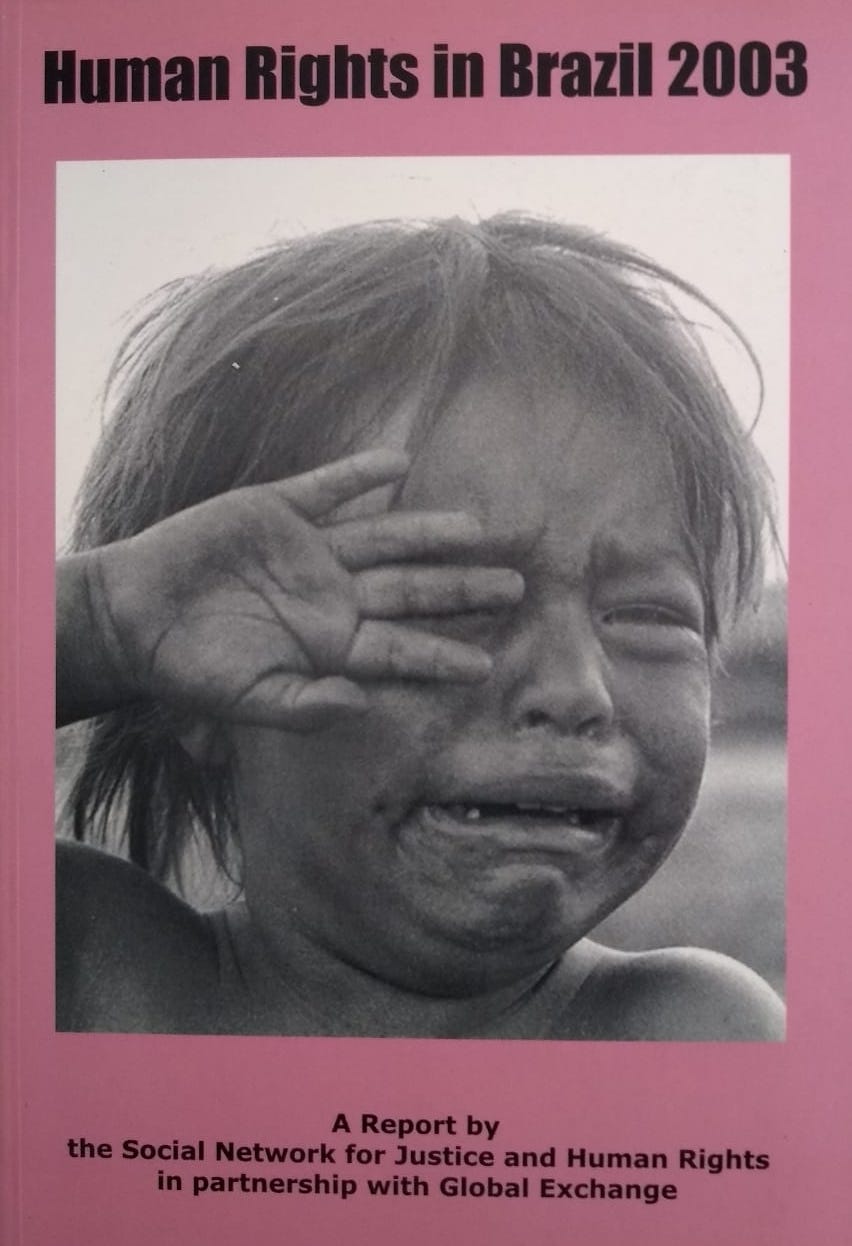
Human Rights in Brazil 2003A Report by the Social Network for Justice and Human Rights in partnership with Global ExchangeEdited by: Evanize Sydow e Maria Luisa MendonçaPhotos: João Roberto RipperGraphic Design: Carlos Vasconcelos PitomboAdministrative Assistance: Graça Silva e Marta Soares…
Preface
Human Rights and Solidarity This was the year that, for the first time, Brazil elected a President of the Republic from humble origins, just like those of the majority of people in this report. The day he was inaugurated, January…
Introduction
Despite society’s expectations for political changes, Brazil still presents a sad picture of fundamental rights violation. With the election of Luiz Inácio Lula da Silva for president, people’s movements strengthened their organizations looking for answers to historical demands, such as…
Violence against Indigenous Peoples: the Bitter Lessons of 2003
The year 2003 has seen a frightening increase in the number of murders of indigenous people in the country. In January alone, the first month of the government of President Luiz Inácio Lula Da Silva, five such homicides were recorded. By the end of February the number rose to nine. By the 29th of March, 12 indigenous people had been killed. Through the first 10 months of the year, there were 22 assassinations and one missing person. In 2002, there were seven such cases. The homicide rate of indigenous peoples is the greatest in the last 10 years, having reached a total of 276 victims in 245 cases.
Latifundium Crimes
The Comissão Pastoral da Terra (Pastoral Land Commission) registered 61murders of rural workers in the period between January and October 2003. Between 1985 and 2002, 1.280 murders were registered among rural workers, lawyers, technicians, religious people and rural worker’s leaders who were engaged in the legal fight for land. From this number of 1.280, only 121 had a trial. Only 14 of the people responsible for the murders were judged. Only seven were found guilty. Another four intermediates were judged, two were found guilty. From the 96 executioners judged, 58 were found guilty.
A Land Drenched in Blood
There is a lot of land in this country in the hands of a few people: 44% of all agricultural land belongs to just 1% of rural owners. And there are many people without land. There are around 15 million people wandering the roads and camps, daring to dream that with so much idle land they can find the piece of earth that may redeem them from poverty and the risk of ending up in a favela in the city. This country never had an agrarian reform.
The latifúndios and their defenses
“People of São Gabriel, don’t let your so-well-preserved city be defiled by the deformed and ragged feet of human excrement. These rats need to be exterminated. If you, my friends of Sao Gabriel, have a crop dusting plane, take a low flight at night and spray 100 liters of gasoline over the canvas tents at the rats’ campsite; there will always be a candle lit to put an end to all of them. If you, my friends of Sao Gabriel, have a .22 hunting rifle shoot it from your car at the encampments, from as far away as possible. The bullet hits its target just as well from 1,200 meters away.”
A pamphlet with these instructions was distributed by farmers from São Gabriel, in Rio Grande de Sul. This is how the big land owners (latifundiários) have treated the rural workers in Brazil.
The pendulum of violence – struggling for land in Paraná in 2003
Groups of hired gunmen (called “private security firms”) are currently the most significant threat to peace in the countryside. By protecting large land holdings in Paraná, these militiamen weaken constitutional authority and create a climate of fear and terror.
Violence and Impunity: Permanent Realityin the state of Pará
Hundreds of people, including conspirators, intermediaries and gunmen, are involved in murder cases in the Brazilian state of Pará. In a city like Xinguara, with 76 rural workers murdered in the last thirty years, there has yet to be a single crime brought to justice. This represents a rate of impunity of 100%. The city of São Geraldo do Araguaia, with 49 murders in the same period, has an identical rate of impunity. This occurs in São Félix do Xingu as well, with 37 murders, and in Marabá, with 35 murders. Among the 40 municipalities that compose south and southeastern Pará, only two, Rio Maria and Eldorado do Carajás, do not have a rate of impunity of 100% in relation to murders of agricultural workers in the last thirty years.
Eldorado dos Carajás
The massacre of Eldorado dos Carajás was not an isolated incident. It puts into context the constant human rights violations in the incessant struggle for a piece of land. It is yet another example where the law ends up being just a piece of paper because the long arm of the state does not assure its fulfillment. It is within this context, as a systematic pattern of violations and impunity, that it should be analyzed.
From the soil of the land to the floorof the jail cell
Although for a year there has been no land occupations in that region, from 2002 to September 2003, Judge Atis issued 12 prison sentences against 46 MST activists. All his decisions were declared illegal by higher courts. The Court of Justice of Sao Paulo granted freedom to 20 farmers, the Criminal Appeal Court granted freedom to four landless workers and the Superior Court of Justice annulled the prison sentence of 22 MST members.
Slave Labor Denunciations Result in New Threats Against CPT Agents, Workers, and Federal Prosecutors
The number of cases of slave labor in the states of Mato Grosso and Maranhão kept increasing: in the first 7.5 months of this year, reports received by the CPT Campaign Against Slave Labor in the states of Pará, Mato Grosso, Tocantins and Maranhão already totaled 229 cases (involving 7,623 workers), as opposed to 127 cases and 5,089 workers in 2002, for the same period. The rescues made up to the end of September (4,256 workers liberated, 895 by the DRT and 3,361 by the Mobile Group) represent almost double the whole year of 2002 (2,152 liberated), although they are still short of the amount needed, if compared to the total number of requests.
Slave Labor and the Creation of Citizenship
Slave workers, distant from their places of origin, from family and friends, find themselves more vulnerable. They are afraid of the gunmen, the bosses, of illness, and have little space in which they can resist. Some run away; others go beyond that, and inform the authorities or human rights organizations.
The profile of slave workers in Brazil
Although many don’t even know their age, one can see they are young. They are generally less than 40 years old. A large number of them have a history of child labor, some together with parents who were also slaves. Many have no documents. Those who have a work card usually have that document taken away by the owner. Slave workers often don’t even know where they will stay. In several reports one will notice that when they are contacted by the “cats” they are told that they will be working in one state but end up being taken to another one. This causes loss of contact with their families. The presence of armed guards in the ranches, in a large number of the cases, is another characteristic of slavery. Few workers take the risk of escaping, especially because there are various cases of people who have been assassinated or seriously injured as they tried to escape from the ranches.
Campaign for a GMO-free Brazil
With the passing of his first months in office, we have already realized that President Lula will be less sensitive to grassroots demands than he had promised. If on the one hand, the nomination of Senator Marina Silva for the Ministry of the Environment appeared to be a gesture which reaffirmed the commitment to the environmental movement, the nomination of Roberto Rodrigues for the Ministry of Agriculture represented a clear signal that agricultural policy was turning toward the right.
United Nations Rapporteur on Right toFood Concludes Study in Brazil
The United Nations Special Rapporteur on the Right to Food concluded that one of the main causes of hunger in Brazil is the enormous area of uncultivated land that, according to INCRA (Agrarian Reform Institute), is around 100 million hectares. Another problem is the enormous concentration of land, where 2 % of the large estate owners hold 56% of the properties and 80% of the small producers hold only 12% of agricultural lands. At the same time, there are 4.8 million rural families without land in the country.
New Shadows Over Alcântara
Currently, the National Congress is analysing an agreement between Brazil and the Ukraine for the use of the Alcântara base. As it is, the agreement has no mechanism to guarantee that the Brazilian government will have access to technology, restricted areas and inspection of materials on the base.
Process of marginalization in Brazil
Social exclusion increased 11% in Brazil between 1980 and 2000. In these two decades, the number of marginalized persons rose from 51 million (42.6% out of 120 million persons) to 80 million (47.3% out of 170 million). The increase in unemployment and violence are the principle factors that contributed to the increase in social exclusion in Brazil. Within the data researched, education was the only area that improved.
Enslaved Bolivian Immigrants in São Paulo
Bolivian immigrants in São Paulo tend to work from 6am to 11pm, and make between R$200 and R$400 ($70 to $140 US dollars) per month. They live in a cubicle in their workplace. These are small rooms, 2.00m x 1.50m, which house the worker, their family, the sewing machines, and a space to put the clothes they produce. A mattress is rolled up during the day, then at night, when they go to sleep, it become their beds. The finished clothes are normally delivered to Koreans who own cheap clothing stores.
Police Violence and Death Squads in São Paulo
From January to May of 2003, the Military Police of São Paulo killed 435 people – an average of almost three homicides daily. These figures reveal an increase of 51 percent relative to the same period in the previous year.
Sapopemba: killing policies in the peripheryof São Paulo
Human rights violations are a part of every day life for most people who live in low-income neighborhoods. In the communities of Sapopemba, there is a feeling of isolation, fear, and insecurity. From January to May 2003, São Paulo’s Military Police killed 435 people, an average of 3 persons per day, and 51% more than in the same period of 2002. The Police Attorney Fermino Fecchio, who denounced these killings, was recently removed from his position under pressure from the Secretary of Security.
Public insecurity in São Paulo: homicides, torture, and corruption
Low wages and the serious economic crisis in the country have resulted in a brutal proliferation of the use of police as private militias. As a result, there is a greater number of cases of police brutality and killings.
Fighting organized crime in the stateof Espírito Santo
Data from the Ministry of Justice for the state of Espírito Santo show rates of homicide that exceed 50 per 100,000 inhabitants and rates of violent crime higher than 100 per 100,000. Organized crime relies on impunity and on corruption in the legal system, such as unfinished trials of various “contract crimes”. During the past year, crimes against life, particularly homicides, rose by 11.2%, from 1,572 in 2001 to 1,771 in 2002. These deaths are, in large part, executions carried out by gunmen or by the police.
Life and Survival in Rio’s favelas
The population of 15-to-24-year-olds in Rio de Janeiro’s metropolitan area is on the order of 1.8 million. According to 1999 data from the National Housing and Population Statistics Research, 684 thousand (38%) have not completed primary schooling. On the other hand, 216 thousand (12%) have at least finished high school. As far as the job market is concerned, 718 thousand (40.1%) have work, while 226 thousand (12.6%) are unemployed. Statistics from Rio de Janeiro’s 53 favelas (slums/shantytowns) show that 62% of young people have not completed primary schooling; barely 1% have finished high school; 51% have jobs or are looking for work, and the unemployment rate is 18.6%.
Access to education in Brazilis still not universal
The country has more than 42 million people above the age of 10 who cannot read or write in their day-to-day life, which represents 31.4% of the population in this age group. In 2001, 49.8% of teachers for basic schooling had not completed higher learning, and 3.1% of them had basic schooling as their only education, completed or not. The worst levels are in the Northern region: 78.2% don’t have higher education and 8.3% don’t have basic education. Docents in the Northeast make 44% less than the national average salary. In considering the indigenous population, the level of exclusion can be seen in the amount of resources devoted to this category in 2003: 0.001% of the federal budget for education.
Education in the Quilombola Communities of Pernambuco
Education in the quilombola1 communities of Pernambuco reflects the general problems of Brazil´s school system. While the Ministry of Education states that close to 97% of the Brazilian children ages 7 to 14 have access to education, there is no precise data for the quilombola children. It is still common to see children and teenagers out of school, as well as illiterate adults. Schools are in very precarious conditions and they do not include cultural differences in their curricula.
In Conceição das Crioulas, descendents of Blacks and Indians take part in the struggle for land and knowledge
The Conceição das Crioulas community was created when the women slaves Francisca, Germana and Mendeira, fleeing from Quilombos dos Palmares, in Alagoas, arrived in the region in the 18th century. From that time on, the strength of the women is making a difference in this district. One of them, Aparecida Mendes, coordinator of the Association of Quilombola de Conceição das Crioulas, travels the world telling the story of her community.
Women’s Rights to Employmentand Fair Wages
The Employment Study of the Inter-Trade Union Department of Statistics and Socio-Economic Studies (DIEESE) points to a higher level of unemployment among women. In August of 2003, the rate of total unemployment in the Metropolitan Region of São Paulo, was 23.6% for women, and 16.5% for men. Between 1995 and 1998, it is estimated that roughly 150 thousand economically active women were incited to leave the workforce to wholly dedicate themselves to their children. Since the beginning of 2003, 300 thousand women have left the workforce. Women with up to three years of schooling receive the equivalent of 61.5% of men’s income, while women with eleven years or more of study receive 57.1% of the income of men.
Traffic in Women, Children and Teenage Girls for the Purpose of Sexual Exploitationin Maranhão
In Maranhão we find the following: a) Children and teenagers from rural towns coming to the city to work as maids who end up being sexually abused by the boss or his/her son; b) children and teenagers who come from the countryside with job offers to work in family homes, but who are sent to prostitution houses; c) Sex traffic in girls who are sent to Holland, Germany, Switzerland and Austria through the port of Itaqui; d) girls, some of them married, who travel with foreigners but once out of the country, are sold by their husbands or dealers.
Housing: A right and a struggle
English Report
One million nine hundred thousand people live in favelas (shantytowns) in São Paulo, a million in slum tenements, and around three million in precarious housing. This reality worsens every year. The number of people living in favelas evolved from one million two hundred thousand in 1990 to almost two million in the year 2000. The number of tenements also grew. Precarious housing on the outskirts (in areas that are not urbanized) grew at a frightening pace. The population living on the street grew to almost 15,000.
Work in the first months of the Lula Government
According to the 2003 United Nations Develop Program (UNDP), Brazil finished the twentieth century with the sixth worst distribution of wealth in the world, behind only Namibia, Botswana, Sierra Leone, the Central African Republic and Swaziland. Unemployment in greater São Paulo is currently in the neighborhood of twenty percent. That is to say, of one out of every five workers is unemployed. This problem is still worse in Salvador, Bahia, where unemployment reached the thirty percent mark-of every three workers, one is unemployed.
The Theater of Labor Reform
Contrary to what modern thinkers proclaim, the intervention of the State in labor relations needs to be deepened rather than minimized. With all the limitations on efficiency, the power of the State is what can counterbalance (even if precariously) the disproportion in power relations.
The National Reports Project for Economic, Social, and Cultural Human Rights
An estimated 50 million Brazilians live below the poverty line. The country also continues to experience widespread human rights violations without practical mechanisms for monitoring the daily accomplishment of rights. These facts alone justify the call for six national reports on Economic, Social, and Cultural Human Rights (ESCHR)-for the rights to Food, Water and Land, the Environment, Health, Adequate Housing, Education, and to Employment. The mandate of these reports includes common elements: the receipt of urgent communications, visits and missions to the states, periodic working group meetings, and annual financial reports.
External and Internal Debt andHuman Rights in 2003
Brazil continues to be one of the leading countries in the world in income inequality, occupying sixth place alongside such extremely poor countries as Namibia and Swaziland. Between January and August of 2003, expenditures with interests on the public debt reached 102.4 billion reais, 68% more than during the same period of 2002. These expenses represent three times the allocation of the federal government to health, 334 times the spending on housing, and 10.2% of the gross national product, or around 30% of all expenses at the three levels of government.
The World Trade Organization and Its Impacts
The destruction of rural economies by the promotion of “free trade” policies has generated a new type of protest, as in the case of the Korean farmer Lee Kyung Hae. During at demonstration in Cancun, Mexico, Lee took his own life. In contrast to the images of despair and insanity showed by the conservative media, Lee’s gesture represents a conscientious sacrifice against the oppression of millions of small farmers. Since the foundation of the WTO, approximately 600 similar deaths have been registered per year in India. Farm workers prefer to die than to see their lands confiscated for not being able to pay the costs of production, especially during drought periods. For this reason, many protesters in Cancun adopted the following slogan: “WTO kills farmers.”
The United States military presencein Latin America
The process of militarization in the continent has caused environmental destruction, human rights violations and repression of social movements, as well as the displacement and forced migration of millions of people. The United States has increased the number of military bases in Latin America, as in case of Manta (Ecuador), Tres Isquinas and Letícia (Colombia), Iquitos (Peru), Queen Beatrix (Aruba), Hato (Curaçao) and Comalapa (El Salvador). Those bases increase the U.S. military presence in the region. The United States government already had military bases in Puerto Rico (Vieques), Cuba (Guantánamo) and Honduras (Soto de Cana). It also intends to build military bases in Argentina (Tierra del Fuego), as well as control the base at Alcântara, in Brazil.
International Responsibility of the State andDecisions of the Inter-American System in 2003
The Inter-American Court unanimously affirmed that human rights extends to all people, including informal immigrants who should have the right to due legal process and labor rights. It is the government’s responsibility to keep private employers from violating the internationally guaranteed rights of workers.
A Report by the Social Network for Justice and Human Rights in partnership with Global Exchange
Preface:
– Human Rights and Solidarity
Dom Paulo Evaristo Arns
I. Human Rights Violations in Rural Areas
– Violence against Indigenous Peoples: the Bitter
Lessons of 2003
Rosane Lacerda
– Latifundium Crimes
Rede Social de Justiça e Direitos Humanos, Comissão Pastoral da Terra, Centro de Direitos Humanos Evandro Lins e Silva e Instituto Carioca de Criminologia
– A Land Drenched in Blood
Frei Betto
– The latifundios and their defenses
Antonio Canuto e Dom Tomás Balduíno
– The pendulum of violence – struggling for land in Paraná in 2003
Jelson Oliveira
– Violence and Impunity: Permanent Reality in the state of Pará
José Batista Gonçalves Afonso
– Eldorado do Carajás
CEJIL Brazil
– From the soil of the land to the floor of the jail cell
Roberto Rainha and Patrick Mariano Gomes
– Slave Labor Denunciations Result in New Threats Against CPT Agents, Workers, and Federal Prosecutors
Fr. Xavier Plassat
– Slave work in Pará
Fr. Xavier Plassat
– Slave Labor and the Creation of Citizenship
Ricardo Rezende
– The profile of slave workers in Brazil
Evanize Sydow
– Campaign for a GMO-free Brazil
Flávia Londres
– United Nations Rapporteur on Right to Food Concludes Study in Brazil
Maria Luisa Mendonça
– New Shadows Over Alcântara
Maria Luisa Mendonça and Aton Fon Filho
II. Poverty and Violence in Urban Areas
– Process of marginalization in Brazil
Marcio Pochmann
– Enlaved Bolivian Immigrants in São Paulo
Evanize Sydow
– Police Violence and Death Squads in São Paulo
Fermino Fecchio
– Sapopemba: killing policies in the periphery of São Paulo
Ana Facundes
– Public insecurity in São Paulo: homicides, torture, and corruption
João José Sady
– Fighting organized crime in the state of Espírito Santo
Tânia Maria Silveira
– Life and Survival in Rio’s favelas
Jailson de Souza e Silva
III. Social, Economic and Cultural Rights
– Access to education in Brazil is still not universal
Sérgio Haddad e Mariângela Graciano
– Education in the Quilombola Communities of Pernambuco
Delma Josefa da Silva
– In Conceição das Crioulas, descendents of Blacks and Indians take part in the struggle for land and knowledge
Evanize Sydow
– The Color of Justice
Jurema Werneck
– Women’s Rights to Employment and Fair Wages
Miriam Nobre
– Traffic in Women, Children and Teenage Girls for the Purpose of Sexual Exploitation in Maranhão
Nelma Pereira da Silva, Arydimar Vasconcelos Gaioso, Cynthia Carvalho Martins e Helciane de Fátima Abreu Araújo
– Housing: A right and a struggle
Manoel Del Rio
– Work in the first months of the Lula Government
Paulo Cesar Pedrini
– The Theater of Labor Reform
João José Sady
– The National Reports Project for Economic, Social, and Cultural Human Rights
Jayme Benvenuto Lima Jr
IV. Globalization and Human Rights
– External and Internal Debt and Human Rights in 2003
Sandra Quintela
– The World Trade Organization and Its Impacts
Maria Luisa Mendonça
– The United States military presence in Latin America
Maria Luisa Mendonça
– International Responsibility of the State and Decisions of the Inter-American System in 2003
Cejil Brasil