



Table of contents
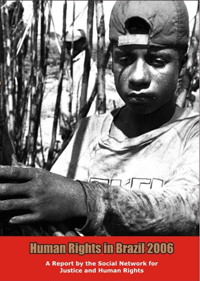
Human Rights in Brazil 2006A Report by the Social Network for Justice and Human Rights Edited by: Evanize Sydow e Maria Luisa MendonçaPhotos: João Roberto RipperGraphic Design: Carlos Vasconcelos PitomboAdministrative Assistance: Marta Soares, Sidnéia Soares e Magali Godoi Translators: Ariane…
A word of gratitude and of commitment
The Network for Social Justice and Human Rights is publishing its annual report on Human Rights in Brazil 2006. This report is fully trustworthy and has a broad reach, covering the following issues:Human Rights in Rural AreasHuman Rights in Urban…
Introduction
In 2006, the Report on Human Rights in Brazil reaches its seventh edition. Once more, the report brings a broad overview of human rights issues, and shows that fundamental rights are still violated in Brazil. It includes 29 articles containing…
Violence and Social Movement Activism in the Countryside
CPT’s partial data from January to August 2006 point to the continuation of a tendency toward decline in social movement actions and in the incidence of violence. The number of killings until the end of August was 18.3 percent lower than in the same period of 2005, when 29 people were killed. The number of displaced families fell from 2,339 between January and August 2005, to 927 during the same period in 2006, 60.37 percent lower. The activity of the judiciary was less intense. There were 31.41 percent fewer people evicted from January to August 2006— 11,065 families, compared with 16,131 families in 2005. The number of jailed workers increased significantly. From January to August 2006, 749 people were imprisoned, 351.2 percent more than during the same period in 2005, 166 more than the totals during previous years. This increase is due above all to the imprisonment of militants of the MLST (Movement for Liberation of the Landless), as a result of their occupation of the Chamber of Deputies in Brasilia.
10 years since the Eldorado dos Carajás massacre – rural movements fight against impunity
The Eldorado dos Carajás massacre took place on the day of the International Day of Rural Struggle – on April 17, 1996, when 19 landless rural workers were assassinated by the Military Police on the “S” Curve of Highway PA-150, and another 69 were injured. Between 1996 and 2006 – 10 years since the Eldorado dos Carajás massacre -, close to 170 landless workers were assassinated in the state of Pará. In 1996 alone, 33 landless workers were assassinated in the state[1]. Rural violence is a sad situation in Pará. It has the largest numbers of cases of slave labor in Brazil. In addition, it was here that ranch owners ordered the assassination of missionary Dorothy Stang, in February of 2005. In spite of the presence of the Army and the Federal Police in Anapu, the city where the nun lived, rural workers still feel unsafe and suffer from regular threats. The majority of large landowners in the state have armed militias. According to the Pastoral Land Commission (CPT), in the last 34 years in Pará, there were more than 770 assassinations of rural landless workers and people that support them. In only three cases there were trials to judge the authors of these crimes.
Prophecies do not change the future
Denounced by our report over a year ago, the traditional strategies of those who defend landowners who order assassinations in the state of Pará— after seeking to postpone court procedures with incidents and interruptions of the legal proceedings— have once again proven efficient against the calls to end impunity. At the court hearings at the Belém Judicial Court District, which tried and convicted Tato as responsible for hiring the executors of the nun Dorothy Mae Stang, human rights defenders sought once again to speed up the proceedings of those accused of hiring the gunmen to commit the crime, Bida and Taradão, by strictly following the time stipulated by the legal proceedings at the Judicial Court of Pará. However, the attempts of these organizations were barred, and were not only slowed to a protracted pace, but all the authorities involved adhere to this sluggish process in the higher courts. Up to this date, the lawsuit remains in the Court of Appeals in Brasilia, with the sole intent of extending these proceedings.
Agrarian Policy in the Lula Government: the Hollowing of Agrarian Reform
The lack of an effective agrarian reform policy feeds the violence in Brazil. What is the difference between the landowner who ordered the killing of landless peasants in Felisburgo, Minas Gerais, and those who ordered the killing of the employees of the Ministry of Labor in Unai? What is the difference between the mill owners in Sao Paulo who, through their administrators, daily work rural laborers to death cutting sugarcane, and members of the “consortium” who paid to have Sister Dorothy Stang killed? In other words, what is the difference between the so-called “modern agribusiness” and the old rural oligarchy?
Peasant Agriculture and Agrarian Reform in Brazil: an Evaluation of the Lula Government
Here we present a brief description of the measures taken during the Lula administration. I. Measures that favored peasant agriculture in Brazil II- Measures that don’t favor peasant agriculture and rural social movements in Brazil Manifesto of the Americas: In…
Labor rights violations and death of sugarcane workers
The majority of sugar workers come from the northeastern states and the Valley of Jequitinhonha, Minas Gerais. In general, when they migrate, they travel clandestinely and are subjected to conditions analogous to slavery. From 2004 to 2006, the Pastoral of Migrants registered 17 deaths that occurred from excessive work. Intensive sweat causes loss of potassium and can lead to cardio-respiratory attacks. Other cases refer to occurrences of aneurysm, the breaking of cerebral veins.
Slavery in Brazil: New and Persistent Issues
While, as the ILO has recognized, there have been positive movements in the fight against slave labor, old obstacles persist, such as impunity, and the non-approval of Proposed Constitutional Amendment 438-2001, which relates to confiscation of property in cases where slave labor occurs. There is a lack of preventive measures in place to generate income for those workers most vulnerable to abuse and measures designed to implement effective land reform.
Violence Against Indigenous Peoples[1]
The continued persistence of violent attitudes toward Indigenous people on the part of the Military Police—killing, abusing, and humiliating—is a serious problem, as are the cover ups and impunity for these police actions. Between the years of 2005 and 2006, more than 80 Indigenous people were criminally prosecuted in an unjust and illegal manner, in relation to conflicts involving struggles for land. Problems such as prejudice, unjust criminalization, ethnic hatred, and disrespect for the rights of indigenous peoples, still persist in Brazil.
The United Nations confirms the denunciations of the Movement of Dam-Affected People
The repression against the Movement of Dam-Affected People (MAB), started when they began to denounce the Brazilian energy model, in which residential consumers pay up to seven times more than large corporations. In 2005, 10 people from MAB were arrested, 109 were being sued, and 20 were wounded during mobilizations. In 2006, four people were arrested, 130 were being sued, and 25 were wounded during mobilizations.
Diversion of the São Francisco River: A contradiction to the human right to water
If the government and the proponents of the project to divert the water of the São Francisco River admitted to the economic reasons behind the operation, the debate would be more transparent and more ethical. Camouflaging conflicting economic interests under the pretext of human thirst is intolerable as it is just a new model of manipulation of the Northeast populations in order to support another large project.
Bahiana region suffers from the impacts of uranium production for nuclear plants
Municipalities from the semi-arid sertão region of Bahia suffer from the noxious socio-environmental impacts caused by the Nuclear Industries of Brazil – INB – responsible for the mineral-industrial complex Lagoa Real/Caetité, which produces uranium for Brazilian nuclear plants. The inhabitants of the region have expressed concern over the announcement in Brazilian energy policy to reactivate the nuclear program, including plants located in the Northeast. More than a dozen “usual nuclear events” and various paralyses of activity, which could add up to more than two years of inactivity, unmask the technical and administrative challenges that the INB faces in order to simultaneously operate the system safely and lucratively. What’s more, these events only feed into doubts regarding the scientific competence of the business to handle such a dangerous product.
Peasant Resistance in Brazil
The settlements of Santana (Ceará), Conquista na Fronteira (Santa Catarina), Antonio Conselheiro (Mato Grosso) and the “quilombo” communities of Oriximiná (Pará) serve as references of organization and resistance. They contrast with the degraded and abandoned farms that lie under the control of a single landowner. When the farms are disappropriated for agrarian reform, despite the land’s precarious conditions, they are able to quickly expand cultivation and livestock.
They did not see the Brazilian soccer team get defeated
Between May and August of 2006, three crime waves rocked the State of São Paulo. Police officers’ involvement with criminals by extorting them, and living off of their money, or getting into disputes with criminals about who has the power to commit crimes, make what is illegal the norm and cast aside the legal norm.
Violence in São Paulo – a frightening balance
Between May 12th and 16th, the Secretary of Public Security of the State of São Paulo published alarming data: in the 251 attacks by the prison gang First Command of the Capital (PCC), and its confrontation with the police, there were 115 deaths, including 32 police officers, 8 prison guards, and 75 people who were shot by both sides.
Structural Unemployment in Brazil
As long as the rate of economic growth remains low, Brazil will tend to specialize in the production and marketing of low value-added goods, with limited technology content and dependent on the low cost of labor. In this sense, economic activity growth may demand more workers, but the profile of employed workers tends to be associated with low compensation and precarious work conditions, not always accessible to highly educated and professionally qualified workers. In a continental country like Brazil, where more than 2.3 million people enter the job market each year, the national economy must grow at least 5% per year to absorb this population. Without it, competition in the job market, even for the simplest positions, will end up driving a reduction of wages and mass unemployment.
Migration and Slave Work
The estimate is that there are between 150-200 thousand undocumented Bolivians living in the city of São Paulo. More than 90% of them work for small factories that are the property of Koreans, Brazilians, and other Bolivians. They work about 18 hours a day, and they get paid $30 cents for each piece they sew. The places where they work, and generally live, are dark, humid, and totally unhealthy. Many people develop respiratory problems or tuberculosis. When the Federal Police free enslaved Brazilians from farms in the Northeast, those workers are free. But when the police find Bolivians in the same situation in São Paulo, the most probable outcome is that they are deported from Brazil. Thus, the immigrants themselves do not want to denounce the situation.
Human trafficking in Brazil
Brazil is described as a country where women and girls are trafficked for sexual exploitation, both within its borders and across South America, the Caribbean, Eastern Europe, Japan, the United States, and the Middle East. This document also states that approximately 70,000 Brazilians, the majority women, are sex workers in foreign countries, many of them victims of human trafficking. Brazil’s main problem, however, is the small number of convictions of human traffickers.
Labor Policies and Human Rights
One argument in favor of the current labor reforms in Brazil is that flexibility allows businesses to adapt to the realities of the market, gain competitiveness, generate economic growth, and therefore increase the creation of jobs. According to recent International Labor Organization (ILO) publications, these types of reforms have not contributed to the generation of employment. They have contributed to the deterioration of the quality of remaining jobs.
Towards a Country for All People
Despite the government’s effort to combat racism, there is still an area that needs more attention, which is public security. This area has not been contemplated in an effective way by the government, so Black people continue to be the main victims of urban violence.
Limits to Access to Education
All indications show that in 2007 resources for the registration of primary and high school students and for basic education for those over fourteen years of age will remain unavailable. Also, according to the Institute of Applied Economic Research (Instituto de Pesquisa Econômica Aplicada–Ipea), the body responsible for ongoing evaluation of the Brazil Literacy Program, the low impact of the program indicates that it is not sufficiently focused on its target public–those who are absolutely illiterate. Of the 60,000 fishers who are absolutely illiterate, only 10% attended the program in 2006. Of the 10,000 collectors of recyclable materials, 20.1% participated. Only 9% of the 15,000 persons living in quilombos participated.
Amazon dilemmas and the Lula administration
In the last 35 years, from 1970 to 2005, 17% of the Amazon forest has been destroyed. The main causes of deforestation are activities related to the extraction of natural resources. Deforestation is a consequence of timber exploitation, cattle ranching, grain production in large farms, charcoal production, as well as large projects, such as roads and dams.
The Right to Culture: Progress and dilemmas facing Lula’s Government in regards to cultural policies
The biggest accomplishment of the current Ministry of Culture is its efforts to establish policies that are based on UNESCO’s Universal Declaration on Cultural Diversity, which recognizes cultural diversity as one of humanity’s landmarks[1]. This means that the State has the obligation to support cultural activities that are usually hidden, or expressed only as “folklore” or exotic art.
The Human Right to Communication: its recognition grows, but violations remain the rule
Aside from the absence of effective policies for the development of various forms of community communication, the Lula government achieved the record for closures of community radio stations. In the first half of 2006, on average, 10 community radio stations were closed per day, totaling 1,800 closures from January to July of this year. Broadcast grassroots organizations known throughout Brazil, such as Radio Lauza (Bahia), Novo Ar (Rio de Janeiro), Heliopolis (Sao Paulo) and Alternativa (Rio Grande do Norte), were closed in an arbitrary and hostile manner, with their leadership subject to political persecution. Simultaneously – and in opposition to the speed and efficiency of the radio station closures – bureaucratic sluggishness continues in force with regard to evaluation of requests by the communities: more than 8,180 applications for authorization were not even considered, and more than 1,800 have been held up in some Communications Ministry office.
The Peoples’ Victory at the WTO
The failure of the Doha Round should serve to demystify certain characteristics of the WTO. One of these is the idea that the WTO as an institution promotes “free trade.” In reality, the main role of the WTO is to establish mechanisms of control over the world market, through the imposition of rules that make national development policies impossible, in areas such as agriculture and industry.
With the help of the United States, the Paraguayan government represses social movements
The Paraguayan Army and police are not the only agents of repression that rural workers must confront. In 2004, the Ministry of the Interior of Paraguay created Citizen Security Councils, security forces composed of civilians financed and armed officially by the government with the justification of aiding in the fight against criminality. However, extra-officially, they are supplied by large ranching interests. In practice, these councils function as paramilitary groups acting in defense of cattle-ranching and soy-producing interests. These new security forces are the chief authors of evictions, the burning of homes, and even incidents of rape and assassination of members of peasant organizations. It is estimated that in the entire country there are approximately 22 thousand men in the Citizen Security Councils. The Paraguayan Army, for example, has about 12 thousand members.
Foreign Debt and Human Rights Violations in Brazil
Toward the end of 2005, the government began anticipatory payments on some parts of the foreign debt. In December of 2005, it paid $15.5 billion to the International Monetary Fund (IMF); in the beginning of 2006 it also eliminated the debt with the Club of Paris (association of creditor governments), paying $1.8 billion; and paid another $6.64 billion in reserves to redeem Brady bonds. Recently, the government announced that it would continue redeeming more bonds to pay down the foreign debt, activating those that should total $20 billion in 2006. The most troubling is that all of the social sacrifice happened in order to reach the growing limit of primary surplus was not sufficient to impede the explosive growth of the federal domestic debt in the last years. Brazil produced a surplus of 3.89% of the GDP in 2002, of 4.25% in 2003, of 4.58% in 2004, of 4.84% in 2005, and of 5.39% of the GDP in the first seven months of 2006, when the internal debt reached R$1.109 trillion reais.
A Report by the Social Network for Justice and Human Rights
I. Human Rights in the Countryside
Violence and Social Movement Activism in the Countryside
Antonio Canuto
10 years since the Eldorado dos Carajás massacre – rural movements fight against impunity
Evanize Sydow
Prophecies do not change the future
Aton Fon Filho
Agrarian Policy in the Lula Government: the Hollowing of Agrarian Reform
Jose Juliano de Carvalho Filho
Peasant Agriculture and Agrarian Reform in Brazil: an Evaluation of the Lula Government
Via Campesina Brazil, The Movement of Small Farmers, The Landless Workers Movement, The Movement of Dam Affected Peoples, The Movement of Peasant Women, The Pastoral Land Commission, The Brazilian Association for Land Reform
Labor rights violations and death of sugarcane workers
Maria Aparecida de Moraes Silva
Slavery in Brazil: New and Persistent Issues
Ricardo Rezende Figueira
Violence Against Indigenous Peoples
Paulo Maldos
The United Nations confirms the denunciations of the Movement of Dam-Affected People
Leandro Gaspar Scalabrin
Diversion of the São Francisco River: A contradiction to the human right to water
Roberto Malvezzi
The state of Bahia suffers from the impacts of uranium production for nuclear plants
Zoraide Villasboas
Peasant Resistance in Brazil
Mônica Dias Martins
II. Human Rights in Urban Areas
They did not see the Brazilian soccer team get defeated
Aton Fon Filho
Violence in São Paulo – a frightening balance
Evanize Sydow
Structural Unemployment in Brazil
Marcio Pochmann
Migration and Slave Work
Luiz Bassegio e Luciane Udovic
Human trafficking in Brazil
Marcia Anita Sprandel
Labor Policies and Human Rights
Paulo César Pedrini
III. Economic, Social, and Cultural Rights
Towards a Country for All People
Lúcia Xavier
Limits to Access to Education
Sérgio Haddad e Mariângela Graciano
Amazon dilemmas and the Lula administration
Lindomar Silva
The Right to Culture: Progress and dilemmas facing Lula’s Government in regards to cultural policies
Antonio Eleilson Leite
The Human Right to Communication: its recognition grows, but violations remain the rule
Diogo Moyses e Cristina Charão
IV. International Policy and Human Rights
The Peoples’ Victory at the WTO
Maria Luisa Mendonça
Evaluation of the World Bank’s Rural Programs in Brazil
Maria Luisa Mendonça
With the help of the United States, the Paraguayan government represses social movements
Igor Ojeda
Foreign Debt and Human Rights Violations in Brazil
Maria Lucia Fattorelli Carneiro